Creating a simple and effective experience for users is vital for any company or organization hoping to get their website off the ground. Simply put, if a user has a bad first experience with a website, it is unlikely that they will come back again. Lack of attention to the user experience is the kiss of death for a webpage. Good user experience means good business. Businesses strive to analyze their return on investment by looking at different conversion rates to measure how many browsers are turning into buyers.
There are 5 planes or elements that help create the user experience--the surface plane, the skeleton plane, the structure plane, the scope plane, the strategy plane. The strategy plane is vital because every other element stems from there. Each element of the website should be used to advance the strategy or purpose.
For example, the motivation behind the American Airlines website is to sell plane tickets. Every element of the webpage, from the aesthetics to the structure, is utilized to advance the strategy. It is an incredibly user friendly website, which always encourages me to use them when I fly.
Showing posts with label digital communications. Show all posts
Thursday, April 4, 2013
Tuesday, April 2, 2013
First Impressions
As someone who frequently gives up on technology because I just can't figure it out, the topic of usability is vitally important. A website that can clearly and efficiently portray its purpose, agenda, and how to navigate around is gold for the technologically impaired. If I can figure out a website quickly, I will love it forever. If it takes me too much time to navigate a site, I will move on quickly and never look back. It is vital for a website to make a good first impression on users.
Yahoo is also incredibly usable. It is less simplistic, but still clear. There is a lot more information, but it is organized in such a way that everything you need is easy to find.
Bing appears simple from the outside, but it is slightly trickier than the others. The homepage looks simple like google, but with more pictures like Yahoo.
But when you search for something on Bing, it tries to connect you to social information as well, but it does not organize it in a particularly efficient way. There are three columns of information that extend fairly far on the webpage.
To look into this idea of first impressions, I decided to analyze search engines. Google got me right off the bat, simply because it is so simple. There is not a lot to distract you, and it is easy to search for exactly what you need.
Yahoo is also incredibly usable. It is less simplistic, but still clear. There is a lot more information, but it is organized in such a way that everything you need is easy to find.
Bing appears simple from the outside, but it is slightly trickier than the others. The homepage looks simple like google, but with more pictures like Yahoo.
Thursday, March 28, 2013
The Points of View
In productions of media, there is always a message to be conveyed, some bit of information to be communicated. It may be theoretical, ideological, moral, instructional. Part of the producer's job is to figure out how to most effectively present their message. Each message is a story, and it is vital for the producer to decide from which point of view to communicate the narrative. All sorts of elements factor into creating a point of view--audio, video, language. However, when it comes to the film element of the message, the point of view is very limited. Videos are, by nature, shot in the third person. Even if the narration of the production is delievered in the first person, video records and relays the action in the third person.
To potray this idea, I attached a scene from one of my favorite movies, Ferris Bueller's Day Off. In the scene, Matthew Broderick is addressing the audience in the second person, talking directly to them as if it's a conversation. But although Broderick is looking directly at the camera, addressing the viewer, the video itself is still very limited in it's point of view. The monologue is second person, but the video is undeniably third.
Thursday, March 21, 2013
Forces Within The Screen
In reading the article "The Two Dimensional Field: Forces Within The Screen," I was taken aback by all the complexity behind the way a viewer perceives an image, and the way in which the producer can control those effects. All of it was very psychological (I took a psychology class my freshman year and it was not my forte to say the least) and crazy to wrap my head around.
The most salient idea in my mind was that of vectors. Vectors can be both visible and invisible, explicit and implied, superficial and emotional. They affect the way we watch something by guiding us towards what we should focus on and influencing how we feel. When I was reading this section, all I could think about were movies--namely action, thriller, adventure type movies. I personally watch maybe one thriller-type movie a year, just since my sensitive psyche is inclined to nightmares. But one movie I particularly enjoy is The Italian Job. I attached one of my favorite scenes from the movie to use as an example.
The producers of this movie use a whole variety of vectors in this scene. The music cues, the motion of the actors, the motion of the camera all influence what we watch and how we feel about it. This scene always brings me to the edge of my seat, which I'm sure is largely to do with how the creators of The Italian Job used forces within the screen to grab and hold my attention.
Monday, March 11, 2013
The Rhetoric of Multimedia
Rhetoric has been described as "the available means of persuasion." In the age of orality and literacy, this meant invention, arrangement, style, delivery, and literary devices. However, the available means of persuasion have greatly expanded in the digital age. With the advancement of technology, there are more tools of persuasion beyond just language. Today, as Anders Fagerjord describes in the article "Multimodal Polyphony: Analysis of a Flash Documentary," "writing, speech, music, sound effects, photography, painting, and camera movement" all contribute to a rhetorical argument. Multimedia can be used as the available means of persuasion.
There are several different ways that multimedia can be used to advance an argument. The concept of "rhetorical convergence" is the idea that when different forms of media come together, they are even more persuasive because they can affect the way the audience not only hears, but also looks at an issue. Even the way the frame moves or the time an image is project on the screen can add meaning. Because of where these technologies show the viewer to focus, the understanding or perception of a scene can be altered. They can also relate the whole to the details and the details to the whole of an image when alternating between micro and macro perspectives.
By using multimedia, you can contextualize images, as well as direct viewers as to where they should look to catch the most important element of the image.
To create some examples, I decided to look at some of my pictures from my semester abroad. If you wanted to zoom out from a picture to the whole scene, you can contextualize a part of the photograph to the whole. This close up of one of my photographs looks merely like a picture of me and my friend Kathleen.
However, once you zoom out, the Eiffel Tower in the background reveals that this image was from our trip to Paris, adding an important element to contextualize the image.
The dialogue recorded over the image can be used to reinforce the point of focus as well. For example, as the image pans back from our faces to reveal the eiffel tower, the voice over could begin to discuss the city of Paris of the history of the tower itself, directing the attention to the background.
There are several different ways that multimedia can be used to advance an argument. The concept of "rhetorical convergence" is the idea that when different forms of media come together, they are even more persuasive because they can affect the way the audience not only hears, but also looks at an issue. Even the way the frame moves or the time an image is project on the screen can add meaning. Because of where these technologies show the viewer to focus, the understanding or perception of a scene can be altered. They can also relate the whole to the details and the details to the whole of an image when alternating between micro and macro perspectives.
By using multimedia, you can contextualize images, as well as direct viewers as to where they should look to catch the most important element of the image.
To create some examples, I decided to look at some of my pictures from my semester abroad. If you wanted to zoom out from a picture to the whole scene, you can contextualize a part of the photograph to the whole. This close up of one of my photographs looks merely like a picture of me and my friend Kathleen.
However, once you zoom out, the Eiffel Tower in the background reveals that this image was from our trip to Paris, adding an important element to contextualize the image.
The dialogue recorded over the image can be used to reinforce the point of focus as well. For example, as the image pans back from our faces to reveal the eiffel tower, the voice over could begin to discuss the city of Paris of the history of the tower itself, directing the attention to the background.
Thursday, February 28, 2013
Back to Orality
When the radio trend swept through the world in the early 20th century, it seemed almost reminiscent of the age of orality--the realm of philosophers like Plato, Socrates, and the Sophists. It was revolutionary in the sense that it shifted away from a mainly visual and literate culture back to the art of public speaking. In Douglas's article "The Zen of Listening," he comments that radio took America "back into the realms of preliteracy, into orality, to a mode of communication reliant on storytelling, listening, and group memory." The radio, like the invention of the written word, once again caused a major shift in society.
Douglas's article suggests that radio fostered a sense of community amongst its audiences more so than a book or a painting could. Americans across the country could tune in to a program, and know that there were thousands of other people listening to the same program at that moment. There is an undeniably sense of unity and commonality developed by this phenomenon. Still today, producers of entertainment try to capitalize on this community aspect of media. Television programs will try and get users to tweet and hashtag about their show so they can be connected to the rest of the audience. This was first developed with the development of the radio.
Photographic Truth: Fact or Fiction?
Photographs often seem factual—it is a captured moment in
time, a piece of visual evidence that is undeniable. Cultural weight is given
to photographs because they are traces of the real. However, what people often
don’t realize is in the same way that a journalist approaches an article with
his own bias, a photographer approaches a photograph with bias as well, and
that can seriously affect the factuality of an image.
The photographer dictates a lot of what message is being
communicated by an image with the lighting, the angle, the focus, the framing,
the moment he or she chooses to capture. While an image can be pretty strong
evidence of what is true, they cannot always be taken at face value, in the
same way that a piece of writing can not be.
With modern technology, the need to develop a critically eye
for photography is escalated further. PhotoShop has revolutionized the way that
photos can be digitally enhanced or manipulated to portray a desired effect.
Because of this, the photographic truth is put under further scrutiny. There is
no guarantee that a photograph represents unbiased truth.
Sturken and Cartwright suggest in their article "Images, Power, and Politics," that the viewer is responsible for how they view images, and the way that they engage what they are viewing. Assessing photographic truth is "one way that we, as viewers, contribute to the process of assigning value to the culture in which we live." While photographic truth is debatable, we, as viewers, can glean truth and meaning if we are critical of the ideologies that may be at play in an image.
Tuesday, February 19, 2013
The Producer or The Viewer... Who has the power?
As is true of most messages, the producer of an image has an intended meaning behind it, but they are unable to be fully in control of the meanings gleaned by their viewers. In their article "Viewers Make Meaning," Sturken and Cartwright discuss the concept of interpellation, or the ability of an image to interrupt a procedure in order to question someone or something formally. This means that since an image poses a question, that leaves space for viewers to disagree or dislike an intended message, even if it is not the response that producers preferred for their viewers.
What I found to be one of the most interesting parts of Sturken and Cartwright's article was the discussion of "taste" and how that is affected by the producer-viewer relationship. Aesthetics are culturally determined, and taste is individually interpreted. People with a high taste level are those who have been educated on that which is considered to have high aesthetic quality, and that which isn't. They have been trained to appreciate "the finer things," but the finer things are socially determined by an individual culture.
One example that the article gave was museums. While studying abroad last semester, I was had the tremendous opportunity to visit several incredible museums, housing some of the worlds finest art. However, it is evident which pieces of art the museum curators deem the most aesthetically pleasing, which plays a large role in shaping what is considered tasteful, and what isn't.
Two of the most prominent museums I got to visit in Europe were the Uffizi in Florence and the Louvre in Paris. The Uffizi is one of the oldest and most renowned art collections in the Western world, housing some of the most significant pieces of art work from the renaissance. When you walk into the Uffizi, the halls and rooms are lined with incredible paintings and statues, but the curators make it clear where you are supposed to guide your attention. There is particular emphasis placed on works such as Botticelli's Primavera, as well as Giotto's Madonna Enthroned with Child and Da Vinci's Annunciation. The curators ensure that the viewer knows the paintings which are the most valuable. Whether there is an entire wall dedicated to solely to one work, or a specially lighting, or prominence in the set up of the room, the viewer is aware which works are important to know for acquiring a high taste level.
In a similar way, the curators of the Louvre in Paris ensure that the viewer knows which pieces of art are of importance to viewers wanting high taste. When you walk down the left wing, you head through a corridor lined with marble statues, and up the staircase to where the Nike of Samothrace is housed. It becomes immediately evident by its isolation that this is a work of great importance.
What I found to be one of the most interesting parts of Sturken and Cartwright's article was the discussion of "taste" and how that is affected by the producer-viewer relationship. Aesthetics are culturally determined, and taste is individually interpreted. People with a high taste level are those who have been educated on that which is considered to have high aesthetic quality, and that which isn't. They have been trained to appreciate "the finer things," but the finer things are socially determined by an individual culture.
One example that the article gave was museums. While studying abroad last semester, I was had the tremendous opportunity to visit several incredible museums, housing some of the worlds finest art. However, it is evident which pieces of art the museum curators deem the most aesthetically pleasing, which plays a large role in shaping what is considered tasteful, and what isn't.
![]() |
| The Uffizi Gallery |
![]() |
| Botticelli's Primavera |
In a similar way, the curators of the Louvre in Paris ensure that the viewer knows which pieces of art are of importance to viewers wanting high taste. When you walk down the left wing, you head through a corridor lined with marble statues, and up the staircase to where the Nike of Samothrace is housed. It becomes immediately evident by its isolation that this is a work of great importance.
![]() |
| Nike of Samothrace |
Also, when you enter the room dedicated mainly to the work of Jacques-Louis David, and the Neoclassical painters, The Coronation of Napoleon, David's most revered work, is housed in the most central point of the left wall.
![]() |
| David's The Coronation of Napoleon |
Despite the fact that curators very intentionally highlighted the most "prominent" works for viewers, I often found myself, despite the clear message of where to focus my attention, being drawn to other works. My favorite work in the Ufizzi is Botticelli's Birth of Venus, which is actually displayed less apparently in the same room as Primavera. Similarly, in the Louvre, I was drawn to a painting on the opposing wall of The Coronation of Napoleon entitled La Liberté Guidant le Peuple by Eugene Delacroix.
![]() |
| Botticelli's Birth of Venus |
![]() |
| Delacroix's La Liberté Guidant Le Peupel |
This goes to show that a producer can put out an image with an intended message or meaning, but ultimately, it is up to the viewer as to what they will glean from a message. They can interpellate the image however they chose, whether that be negatively or positively. The power is undeniably in the hands of the viewer.
Tuesday, February 12, 2013
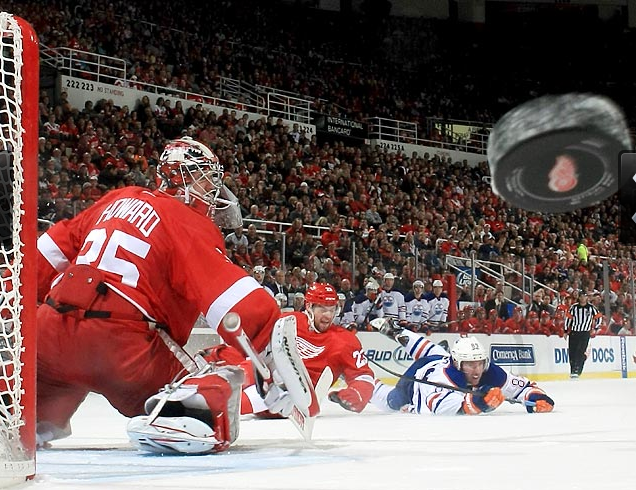
Sports Photography
Sports Photography is a distinct genre of still photography, because it captures a moment of athleticism. It is defined by the action shot, which Rowe describes in his article "Framed and Mounted: Sport Through the Photographic Eye" is responsible for "reinforcing and conferring status on the elite sporting body by showing it doing the extraordinary things that so many people admire and envy." Sports photography displays a single moment of athletic distinction that makes the viewer stand in awe of the competitor and wish to either be a part of or witness that moment. The purpose of sports photography, like any other photography, is to draw the audience in.
To look for examples of Sports Photography, I visited Sports Illustrated Online to look at their Pictures Of The Week. Each photograph captures an intense moment--there is no photograph highlighted that is of a player or athlete merely spectating or waiting. The vast majority of the photographs were of male athletes engaging in intensely competitive confrontations, such as these...
Rowe comments in his article that there is a notable marginalization of women in sports media, which is made obvious by the fact that only 1/3 of sports photography is of women. Out of 18 photos of the week, only three depicted female athletes, all of whom are performing independently without direct interaction with a competitor..
To look for examples of Sports Photography, I visited Sports Illustrated Online to look at their Pictures Of The Week. Each photograph captures an intense moment--there is no photograph highlighted that is of a player or athlete merely spectating or waiting. The vast majority of the photographs were of male athletes engaging in intensely competitive confrontations, such as these...
Of the remaining 15 photos, 14 display men, with only one other exceptionally cute, marginalized form of athlete represented...
Woof. I'm sorry... If a puppy on a treadmill isn't the cutest thing you've ever seen, you're wrong.
Thursday, February 7, 2013
Still Photography
In their article "Digital Still Photography," Quinn and Filak argue that still photography is more powerful than video, because rather than displaying images for a passive audience, still photos allow the viewer to chose how to long to look and where. This concept was fascinating to me, and I immediately flashed back to the 2012 Summer Olympics in London when McKayla Maroney executed a perfect routine on the vault. There were pictures and videos all over the internet documenting her vault.
While some might argue that the still photography is more powerful at depicting the intensity of a moment, I think that they are powerful in different ways. With a video, you can see the full effect from beginning to end. As an example, I've attached a video clip of Maroney's vault routine.
It is undeniable that watching the whole performance from start to finish is unlike anything else. Her execution is perfect, and her ability is amazing. However, there is a different kind of power to a still photo--no more powerful, no less powerful. It is simply achieves a different purpose. A still frame captures the intensity of a single moment in time.
The other thing I found interesting about Quinn and Filaks's article was the idea that even photojournalists need to be held to ethical standards. Photojournalists, just like regular journalists, they are capable of skewing the truth, and so skewing public opinion. Quinn and Filaks urge that photojournalists must use their photographs to "tell a story that reflects what actually happened." While photographers don't need to use a method of verification, they do need to ensure that there is minimal interference with the integrity of a photograph, event, or article.
Tuesday, February 5, 2013
Citizen Journalism and Blogging Brands
Citizen Journalism
Citizen journalism has proved to be one of the most profound impacts of the development of digital media. Countries that experienced extreme government censorship of the press were suddenly gifted with a platform from which to share their opinions, perspectives, and original reporting. Joseph Liebling once wrote, "Freedom of the press is guaranteed only to those who own one." The internet has greatly reduced the costs of production and distribution of information--essentially, everyone has access to their own printing press.This effect can be clearly seen in the Arab spring--a wave of revolutionary demonstrations and protests, egged on by the dissemination of information through digital media. Average citizens were able to document what was going on with their smart phones and share that with their friends or followers. This had a domino effect on the Arab nations and soon, countries like Tunisia, Libya, and Egypt were caught up in their own revolutions.
While this idea has been given the title "Citizen journalism," I don't know that what they were doing was really journalism at all. Often, these "citizen journalists" would be communicating impassioned, biased statements that were completely unverified. If journalism of verification is the standard for true journalism, then maybe it would be more appropriate to title them something other than journalists. However, these "citizen journalists" are not necessarily valued for their credibility, but rather for their authenticity.
Blogging Brands
The way that bloggers create revenue depends on the brand of the blog--corporate, professional, or independent. Prior to beginning my digital communications class, I was unaware that corporations even had blogs. So, I decided to check out a couple of my favorite clothing companies to see if they kept a blog. Anthropologie, J Crew, Free People all have their own blogs where they show you creative ways to use or wear their products (etymologie, J.Crew Blog, Bldg 25 respectively).
These blogs don't need any commercial advertisements because the corporations are already pulling in revenue from their products. They simply improve customer relations. However, some independent bloggers make a comfortable living off of their blogs through advertisements. For example, Green Wedding Shoes is a wedding blog run by a couple in the Los Angeles area. It is incredibly popular in Southern California--I have friends who will swear by it. They fund their blogging escapade through advertisers.
Branding is a really important aspect of blogging, because it determines the reader's approach to the blog as well as the blogger's.
These blogs don't need any commercial advertisements because the corporations are already pulling in revenue from their products. They simply improve customer relations. However, some independent bloggers make a comfortable living off of their blogs through advertisements. For example, Green Wedding Shoes is a wedding blog run by a couple in the Los Angeles area. It is incredibly popular in Southern California--I have friends who will swear by it. They fund their blogging escapade through advertisers.
Branding is a really important aspect of blogging, because it determines the reader's approach to the blog as well as the blogger's.
Thursday, January 31, 2013
A Happy Medium
My views on the Internet are undeniably cynical. Part of me can't help but feel that the Internet and digital media are being glorified as an academic discipline while simultaneously stunting our intellectual growth. But the more I read, the more I realize that I am not the only person to resent change in the intellectual landscape.
Plato was a major opponent of the written word. In
her article "Blogs, Communities, and Networks," Rettberg notes that
Plato "argued that writing creates a distance between author and reader
that does not exist in a conversation, because you can read a text when the
author is absent. That distance, Plato argued, made texts unresponsive. If you
ask a text a question, it will 'preserve a solemn silence'."
In my mind, the written word has always been the
ultimate in rhetoric and communication. It is powerful and effective, able to
move and challenge the audience without being subject to imperfect oratory, and
able to stand the test of time. However, it hasn’t always been the premiere
mode of communication. There was a time when oratory was the dominant mode of
communication, and great scholars like Plato were skeptical of the effects of literacy.
Plato’s greatest critique of written word was that
it was unresponsive. If you didn’t understand what the author intended by a
word or a statement, the text is unable to defend itself. Plato was a firm
believer in discourse—a dialogue where ideas are discussed and questions can be
posed and answered. The written word is simply disseminated, but the word
itself is unable to enter a dialogue.
A blog is, in a sense, a happy medium between
dissemination and dialogue—a text that can respond. Walter Ong, a prominent
scholar of electronic media, characterized our cultural transition from print
to digital media as “a secondary orality, a return in someways to a cultural
more like that of the ancient Greeks than of the post-Gutenberg society.” The permanency
and salience of the written word collide with the discourse and thoughtfulness
of orality in the blogosphere. Bloggers link to other bloggers. Readers survey
the works and are able to respond in the comments section. The authorship can
then address the questions being posed by the audience.
In her article “From Bards to Blogs,” Rettberg
comments that “with every media shift there have been skeptical voices
lamenting the loss of whatever characteristics the previously dominant medium
was perceived as promoting.” There has always been, and will always be, some
form of hesitation towards major changes in the way society and scholarship
function. While I do believe that some level of skepticism towards the internet healthy, it was reassuring to hear that even literacy, which has undeniably benefited the history of the human race, was met with some uncertainty.
Tuesday, January 29, 2013
Journalism vs. Blogging?
One of the major critiques of blogging is that there is not enough objectivity or accountability in their reporting. Jonathan Klein, a former executive vice president of CBS news, claimed that "you couldn't have a starker contrast between the multiple layers of checks and balances [of professional journalists] and a guy sitting in his living room in his pajamas writing." While that concern is valid, what about the various pressures that professional news sources are under? Wouldn't a news corporation like CBS be under more pressure to sensationalize stories to receive high ratings and please their advertisers? That can affect the objectivity and accountability of reporting as well.
The fact is that these days, bloggers can be journalists, and journalists can be bloggers, by virtue of the fact that original reporting can be delivered both professionally and unprofessionally. The same goes for opinion and commentary--it is not limited to either sphere. Blogs can even be called a form of journalism if they deliver original reporting that has been verified, and if it is delivered with speed and transparency. Also, news blogs that fixate on opinion and commentary are inextricably linked to journalism because they rely on journalists to provide them with topics and issues to comment on. Blogging and Journalism, rather than being at odds with one another, have become interdependent.
Thursday, January 24, 2013
The Evolution of Social Media
The findings of Sir Isaac Newton, the British scientist who discovered gravity and the three laws of motion, were absolutely revolutionary. Humbly, he once wrote "If I have seen further, it is by standing on the shoulders of giants." This is just as true now as it was for Newton then. Newton leaned on the work of men that came before to lead him to his findings, as did the revolutionaries of today.
Often, I have found myself giving ample amounts of credit to Mark Zuckerberg, Jack Dorsey, and Silicon Valley for inventing Facebook, Twitter, iPhones, and other elements of digital media that define the way we socialize. However, it is undeniable that they were standing on the shoulders of giants from generations past. Concepts for these social media outlets were not invented by these men; they were built on the foundations of ideas dreamed up long before their time.
As I read Hernandez's article from Wired.com "Facebook?! Twitter?! Instagram?! We Did That 40 Years Ago," I was struck by the similarity of these concepts from decades past that so closely resembled what we have today. One program in particular, Plato, reminded me of one of my favorite scenes from the 80's movie Pretty In Pink...
Often, I have found myself giving ample amounts of credit to Mark Zuckerberg, Jack Dorsey, and Silicon Valley for inventing Facebook, Twitter, iPhones, and other elements of digital media that define the way we socialize. However, it is undeniable that they were standing on the shoulders of giants from generations past. Concepts for these social media outlets were not invented by these men; they were built on the foundations of ideas dreamed up long before their time.
As I read Hernandez's article from Wired.com "Facebook?! Twitter?! Instagram?! We Did That 40 Years Ago," I was struck by the similarity of these concepts from decades past that so closely resembled what we have today. One program in particular, Plato, reminded me of one of my favorite scenes from the 80's movie Pretty In Pink...
This version of instant messaging and digital media looks completely archaic to me and my generation, but at the time it was futuristic. Part of me can't help but wonder if Mark Zuckerberg saw this movie when he was a kid and was inspired by the idea of social digital communication, and remembered this scene when he went to create Facebook messaging. While I am unsure of whether or not Zuckerberg is a fan of Molly Ringwald movies, the question still stands--where are these innovators of social media getting there inspiration? Undeniably, they have been building off the ideas generations past.
That being said, they have undeniably done wonders with these dated ideas and brought them up to the 21st century...
Comparing Molly's clandestine internet messaging in the library to the modern wonders of Facebook, Twitter, and the Social Media Revolution, it becomes evident that although they were standing on the shoulders of giants, modern innovators have done wonders with the web, and should be given the ample amounts of credit they are due.
Tuesday, January 22, 2013
Verification, Headlines, and Hypertext
Over the years, objectivity has become the obsession of the journalistic world. Every magazine, newspaper, and news channel is eager to present themselves as fair and balanced. In their article "Journalism of Verification," Kovach and Rosensteil explicate what objectivity should mean for the modern journalist. They would argue that "fairness and balance take on a new meaning. Rather than high principles, they are really techniques--devices--to help guide journalists in the development and verification of their accounts." Their argument is valid, because no journalist can truly be unbiased. People come with opinions--opinions that affect the way they search for evidence, the way they ask questions, the way they report what they have found. Verification is important because it helps "journalists to develop a consistent method of testing information--a transparent approach to evidences--precisely so that personal and cultural biases would not undermine the accuracy of their work."
Kovach and Rosenteil included five steps of Verification:
1. Never add anything that was not there.
2. Never deceive the audience.
3. Be transparent as possible about your methods.
4. Rely on your own original reporting.
5. Exercise humility.
In my opinion, all of these fall under the overarching umbrella of transparency. It is not only vital for a journalist to be transparent about their methods, but also any potential biases, mistakes, or misunderstandings that could come from their work. Humility would closely trail transparency, because being transparent, human error is a reality of all work.
In Brian Carroll's book Writing for Digital Media, he discusses the concept of headlines and hypertext, both of which infuriate me to no end. Headlines and hypertext validate people who chose to scan articles rather than engage them, which is detrimental to the journalistic field. If journalists are required to write inverted-pyramid style articles that are broken up by section in order to keep readers attention, they are doing so instead of being given free reign to delve into the depths of an issue as they chose, or truly expand on the circumstances at hand. Even further, chunking these articles into small manageable paragraphs and then headlining them accordingly allows people to skip over what they don't want to read, or skip to what they do. This method is not encouraging people to be thoughtful about the issues or giving them a fully rounded mindset.
Also, news websites such as BBC, CNN, and World News all provide long headlines for articles that give viewers the gist of the story without even having to read it. For example, a few headlines from BBC today read:
-Netanyahu Set Back in Israel Poll
-European Transaction Tax Agreed
-Attacks in Nigeria Leave 23 Dead
This style of writing for digital media is not doing the population any favors, as it once again enables readers to be informed, but not knowledgable about the troubles facing our world.
Thursday, January 17, 2013
NPR Case Study
What
is your first impression of the site?
The
website is organized and not overwhelmed with pictures or text. Headlines are
clearly laid out at the top and the different genres of news are clearly marked
below. It is well divided on the site, and the viewer can see the different
sections that are available to them. It also followed the three second rule
because it loaded quickly.
How
does this site establish credibility? How does it establish trust? Or does it?
It
does establish credibility.
- It
is a well respected organization and well known (National Public Radio)
-It
has been updated recently (Copyright 2015)
-Definitely
is professionally designed
-Comprehensive info that is attributed to a certain source, and if you click the
authors name of a particular article, their credentials are listed
-Viewer
has access to the websites privacy policy
-Easily accessible “contact us” link
-Search capabilities
-AURL that ends in .org
What
is the general writing style?
The
writing is very concise and does not show any flowery or overly lengthy
writing. The articles seem fairly objective from the articles that we observed.
The language is simple and clear, easy to read.
Does
the writer identify with his or her readers, or not? How (or why not)?
Not
particularly. We are not sure if it is very important for an author of a news
article to relate to one’s reader. The author should remain objective and
communicate the news.
Does
the writing style get to the point?
Yes.
How
is it arranged? Is it arranged in reverse pyramid style?
It
is definitely in the reverse pyramid style. It presents the most important
points/main point in the first paragraph and then elaborates from there.
Is
content shaped for scanning? How is the content layered?
Yes.
It is broken up into very small paragraphs and has subheadings which makes the
articles easy to scan and find information.
Is
the tone or rhythm of the site consistent throughout?
NPR
seems to have a consistent tone throughout its site. The news articles seem to
demonstrate a similar and professional tone.
How
does the site use headlines?
It
uses them! They are bigger, bolder, and sometimes colorful. The headlines give
a good description of what the article entails.
How
does it use links? Effectively or not?
The
links are there and they work.
How
is multimedia used? It is distracting? How is it displayed on the site? Does
the multimedia tell the same story as the same text, or as different side of
the story?
We think that the pictures and videos
definitely enhance the articles. They are pertinent to the information and are
not distracting. They are integrated into the progression of the article, and
do not overwhelm the article.
How
does the site “package” the stories?
NPR
does not seem to consistently package story. In some articles, there are
packages, and in others there are not.
How
are graphics used?
Graphics are used pretty sparingly. They
are interspersed with text and do not overwhelm or crowd the eye.
Can
each page stand on its own?
Each
page seems that it can stand on its own. On each individual page, you can
access home, other subcategories, and links to the privacy policy, and contact
link.
How
is the navigation? Do you get lost? Do you always know where you are? How or
why not?
The
navigation is really easy. You can’t really get lost because you can always get
home (always located at the top left hand corner of the page).
How
does the site incorporate/interact with its audience? How does it embody the
social aspect of the internet?
In
the top right corner of the website you can access the “social network”
element. At the bottom of the page you can click a link to follow NPR on
Facebook and Twitter.
How
would you rate the usability of the site? Elaborate...
We
feel that the NPR website is very user friendly. You feel that you can access
all the articles and can’t get lost on the website. Everything works
efficiently and follow the three second rule.
How
would you improve the site?
The
website is a little bit congested. There could be a little bit more free space.
Maybe give each section a little more room to breathe, and don’t put them on
top of each other.
A Superficial Shift
While I recognize that the progression of digital media in the past decade is an incredible feat, I can not help but be discouraged by its effects on human habits. In my life, very few things have the ability to make me happier than an eloquently phrased idea or an effectively executed analogy. Since I was a child, I've had a fascination with words--the way they can stir us, still us, mold us, and change us. But those effects require the careful deliberation and undivided attention of the reader, and I believe that the internet has in many ways discouraged us from this kind of profound thought. This is just as relevant for me as for anyone else. When I visit a website, I don't want to take the time to dive into a lengthy article. I scan a webpage for the information I need, and then move on as quickly as possible. Brian Caroll's Writing for Digital Media confirms that this is true for most internet users, and so producers of content are forced to write with this truth in mind. Although it may occasionally be found there, the internet simply does not encourage quality writing.
According to Caroll, the job of a digital media writer is to respond to these trends by occupying three roles--the communicator of a message, the organizer of information, and the interpreter. They are urged to appeal to web users who are "monsters of impatience," and by doing so "switch from 'think paper' to 'think Web' mode." Writers and producers of digital media are under pressure to create work that is scannable and skimmable, with multimedia rich elements and linking to help the user explore a topic more in depth beyond the article itself. Often, visual style is more more important than the information itself. If content is easy to find, easy to read, and aesthetically appealing, it will attract the attention of more people.
Maybe I am cynical, but I find it very hard to believe that this conducive to great work. It seems to me that writers are being asked to dumb down their work for an intellectually lazy population. Curiosity and the pursuit of knowledge have been superseded by convenience and quick facts. Writing has become vastly more superficial to meet the expectations and demands of internet users.
Is the internet reducing the amount of quality work produced, or simply creating a whole new genre of communication? Should digital media writers and creators continue to mold their work to meet the trends of internet readers, or rather should they stay true to good authorship and force the public to elevate their standards?
According to Caroll, the job of a digital media writer is to respond to these trends by occupying three roles--the communicator of a message, the organizer of information, and the interpreter. They are urged to appeal to web users who are "monsters of impatience," and by doing so "switch from 'think paper' to 'think Web' mode." Writers and producers of digital media are under pressure to create work that is scannable and skimmable, with multimedia rich elements and linking to help the user explore a topic more in depth beyond the article itself. Often, visual style is more more important than the information itself. If content is easy to find, easy to read, and aesthetically appealing, it will attract the attention of more people.
Maybe I am cynical, but I find it very hard to believe that this conducive to great work. It seems to me that writers are being asked to dumb down their work for an intellectually lazy population. Curiosity and the pursuit of knowledge have been superseded by convenience and quick facts. Writing has become vastly more superficial to meet the expectations and demands of internet users.
Is the internet reducing the amount of quality work produced, or simply creating a whole new genre of communication? Should digital media writers and creators continue to mold their work to meet the trends of internet readers, or rather should they stay true to good authorship and force the public to elevate their standards?
Tuesday, January 15, 2013
A World Gone Digital
In reading his article "Is Google Making Us Stupid?" from the July/August 2008 edition of the Atlantic magazine, I gradually began to resent author Nicholas Carr for his comments on today's generation's inability to focus on dense works of literature, as well as their failure make in depth connections about that which they read. As a Communications major with a focus on rhetoric, I took great personal offense to these statements. Patronizing, illegitimate, cynical were all words that came to mind as I read his case about the affects of the Internet on the brain. In the same breath as my disapproval, I had already disengaged from the article and begun to browse Pinterest for recipes while composing a text to my roommates about our dinner plans. In that moment, I was struck by just how true his statements were. Something has assuredly changed in the way my brain, and other's brains, operates.
It is irrefutable that the Internet has revolutionized society, but I had never before considered the effect that it would have on the human brain. According to Carr, the Internet has the tendency "to scatter our attention and diffuse our concentration," and since people today are shifting much of their reading to the Internet, this greatly affects the manner in which the brain operates. When I got over my initial qualms with Carr's argument and reflected on my personal habits, I could see how much his argument rings true. I cannot maintain focus on an article or a book or an argument as long as I feel I am supposed to. My brain is not conditioned to handle large amounts of thick argument or intricate wording. Since much of my literate life is centered around the web, my "intellectual technologies" have been reprogrammed accordingly. I expect clear, concise snippets of information.
However, I would not be quick to claim that the Internet is making us stupid. Socrates feared the effect of the written word would stunt intellectual growth, because "he couldn’t foresee the many ways that writing and reading would serve to spread information, spur fresh ideas, and expand human knowledge (if not wisdom)." In the same way, the Internet has begun a whole new sphere of intellectual activity and creativity which will undoubtedly flourish in the coming years. This brings into play the concept of "electracy" which "is to digital media what literacy is to alphabetic writing: an apparatus, or social machine, partly technological, partly institutional." Our intellectual technologies have been reprogrammed due to the Internet, and the ability to collect and decode information from digital media and contribute to the web becomes a skill set necessary for any member of the modern generation.
As someone who is relatively unversed in the ways of technology, my biggest aversion to electracy and the Internet is the thought that it can sometimes give precedence to the calculable over that which is beyond calculation, and I see it reflected in my own life--I expect clear, quick, and simple answers to my questions, which has often discouraged me from curiosity. Carr recognizes this shift in attitude, and notes that in the digital age, "ambiguity is not an opening for insight but a bug to be fixed." If the world can reach a healthy equilibrium between the concrete objectivity of the Internet and the stimulating relativity of thought and debate, than electracy will be of great benefit to the modern world.
It is irrefutable that the Internet has revolutionized society, but I had never before considered the effect that it would have on the human brain. According to Carr, the Internet has the tendency "to scatter our attention and diffuse our concentration," and since people today are shifting much of their reading to the Internet, this greatly affects the manner in which the brain operates. When I got over my initial qualms with Carr's argument and reflected on my personal habits, I could see how much his argument rings true. I cannot maintain focus on an article or a book or an argument as long as I feel I am supposed to. My brain is not conditioned to handle large amounts of thick argument or intricate wording. Since much of my literate life is centered around the web, my "intellectual technologies" have been reprogrammed accordingly. I expect clear, concise snippets of information.
However, I would not be quick to claim that the Internet is making us stupid. Socrates feared the effect of the written word would stunt intellectual growth, because "he couldn’t foresee the many ways that writing and reading would serve to spread information, spur fresh ideas, and expand human knowledge (if not wisdom)." In the same way, the Internet has begun a whole new sphere of intellectual activity and creativity which will undoubtedly flourish in the coming years. This brings into play the concept of "electracy" which "is to digital media what literacy is to alphabetic writing: an apparatus, or social machine, partly technological, partly institutional." Our intellectual technologies have been reprogrammed due to the Internet, and the ability to collect and decode information from digital media and contribute to the web becomes a skill set necessary for any member of the modern generation.
As someone who is relatively unversed in the ways of technology, my biggest aversion to electracy and the Internet is the thought that it can sometimes give precedence to the calculable over that which is beyond calculation, and I see it reflected in my own life--I expect clear, quick, and simple answers to my questions, which has often discouraged me from curiosity. Carr recognizes this shift in attitude, and notes that in the digital age, "ambiguity is not an opening for insight but a bug to be fixed." If the world can reach a healthy equilibrium between the concrete objectivity of the Internet and the stimulating relativity of thought and debate, than electracy will be of great benefit to the modern world.
Subscribe to:
Posts (Atom)