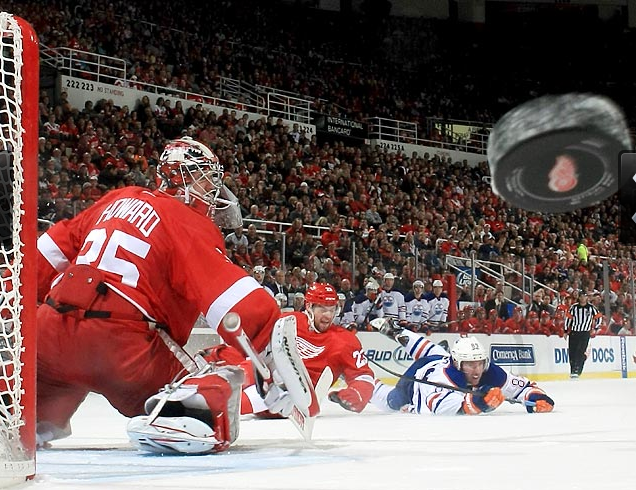
Sports Photography is a distinct genre of still photography, because it captures a moment of athleticism. It is defined by the action shot, which Rowe describes in his article "Framed and Mounted: Sport Through the Photographic Eye" is responsible for "reinforcing and conferring status on the elite sporting body by showing it doing the extraordinary things that so many people admire and envy." Sports photography displays a single moment of athletic distinction that makes the viewer stand in awe of the competitor and wish to either be a part of or witness that moment. The purpose of sports photography, like any other photography, is to draw the audience in.
To look for examples of Sports Photography, I visited Sports Illustrated Online to look at their Pictures Of The Week. Each photograph captures an intense moment--there is no photograph highlighted that is of a player or athlete merely spectating or waiting. The vast majority of the photographs were of male athletes engaging in intensely competitive confrontations, such as these...
Rowe comments in his article that there is a notable marginalization of women in sports media, which is made obvious by the fact that only 1/3 of sports photography is of women. Out of 18 photos of the week, only three depicted female athletes, all of whom are performing independently without direct interaction with a competitor..
Of the remaining 15 photos, 14 display men, with only one other exceptionally cute, marginalized form of athlete represented...
Woof. I'm sorry... If a puppy on a treadmill isn't the cutest thing you've ever seen, you're wrong.
In their article "Digital Still Photography," Quinn and Filak argue that still photography is more powerful than video, because rather than displaying images for a passive audience, still photos allow the viewer to chose how to long to look and where. This concept was fascinating to me, and I immediately flashed back to the 2012 Summer Olympics in London when McKayla Maroney executed a perfect routine on the vault. There were pictures and videos all over the internet documenting her vault.
While some might argue that the still photography is more powerful at depicting the intensity of a moment, I think that they are powerful in different ways. With a video, you can see the full effect from beginning to end. As an example, I've attached a video clip of Maroney's vault routine.
It is undeniable that watching the whole performance from start to finish is unlike anything else. Her execution is perfect, and her ability is amazing. However, there is a different kind of power to a still photo--no more powerful, no less powerful. It is simply achieves a different purpose. A still frame captures the intensity of a single moment in time.
The other thing I found interesting about Quinn and Filaks's article was the idea that even photojournalists need to be held to ethical standards. Photojournalists, just like regular journalists, they are capable of skewing the truth, and so skewing public opinion. Quinn and Filaks urge that photojournalists must use their photographs to "tell a story that reflects what actually happened." While photographers don't need to use a method of verification, they do need to ensure that there is minimal interference with the integrity of a photograph, event, or article.
Citizen journalism has proved to be one of the most profound impacts of the development of digital media. Countries that experienced extreme government censorship of the press were suddenly gifted with a platform from which to share their opinions, perspectives, and original reporting. Joseph Liebling once wrote, "Freedom of the press is guaranteed only to those who own one." The internet has greatly reduced the costs of production and distribution of information--essentially, everyone has access to their own printing press.
This effect can be clearly seen in the Arab spring--a wave of revolutionary demonstrations and protests, egged on by the dissemination of information through digital media. Average citizens were able to document what was going on with their smart phones and share that with their friends or followers. This had a domino effect on the Arab nations and soon, countries like Tunisia, Libya, and Egypt were caught up in their own revolutions.
While this idea has been given the title "Citizen journalism," I don't know that what they were doing was really journalism at all. Often, these "citizen journalists" would be communicating impassioned, biased statements that were completely unverified. If journalism of verification is the standard for true journalism, then maybe it would be more appropriate to title them something other than journalists. However, these "citizen journalists" are not necessarily valued for their credibility, but rather for their authenticity.
Blogging Brands
The way that bloggers create revenue depends on the brand of the blog--corporate, professional, or independent. Prior to beginning my digital communications class, I was unaware that corporations even had blogs. So, I decided to check out a couple of my favorite clothing companies to see if they kept a blog. Anthropologie, J Crew, Free People all have their own blogs where they show you creative ways to use or wear their products (etymologie, J.Crew Blog, Bldg 25 respectively).
These blogs don't need any commercial advertisements because the corporations are already pulling in revenue from their products. They simply improve customer relations. However, some independent bloggers make a comfortable living off of their blogs through advertisements. For example, Green Wedding Shoes is a wedding blog run by a couple in the Los Angeles area. It is incredibly popular in Southern California--I have friends who will swear by it. They fund their blogging escapade through advertisers.
Branding is a really important aspect of blogging, because it determines the reader's approach to the blog as well as the blogger's.
My views on the Internet are undeniably cynical.
Part of me can't help but feel that the Internet and digital media are being
glorified as an academic discipline while simultaneously stunting our
intellectual growth. But the more I read, the more I realize that I am not the
only person to resent change in the intellectual landscape.
Plato was a major opponent of the written word. In
her article "Blogs, Communities, and Networks," Rettberg notes that
Plato "argued that writing creates a distance between author and reader
that does not exist in a conversation, because you can read a text when the
author is absent. That distance, Plato argued, made texts unresponsive. If you
ask a text a question, it will 'preserve a solemn silence'."
In my mind, the written word has always been the
ultimate in rhetoric and communication. It is powerful and effective, able to
move and challenge the audience without being subject to imperfect oratory, and
able to stand the test of time. However, it hasn’t always been the premiere
mode of communication. There was a time when oratory was the dominant mode of
communication, and great scholars like Plato were skeptical of the effects of literacy.
Plato’s greatest critique of written word was that
it was unresponsive. If you didn’t understand what the author intended by a
word or a statement, the text is unable to defend itself. Plato was a firm
believer in discourse—a dialogue where ideas are discussed and questions can be
posed and answered. The written word is simply disseminated, but the word
itself is unable to enter a dialogue.
A blog is, in a sense, a happy medium between
dissemination and dialogue—a text that can respond. Walter Ong, a prominent
scholar of electronic media, characterized our cultural transition from print
to digital media as “a secondary orality, a return in someways to a cultural
more like that of the ancient Greeks than of the post-Gutenberg society.” The permanency
and salience of the written word collide with the discourse and thoughtfulness
of orality in the blogosphere. Bloggers link to other bloggers. Readers survey
the works and are able to respond in the comments section. The authorship can
then address the questions being posed by the audience.
In her article “From Bards to Blogs,” Rettberg
comments that “with every media shift there have been skeptical voices
lamenting the loss of whatever characteristics the previously dominant medium
was perceived as promoting.” There has always been, and will always be, some
form of hesitation towards major changes in the way society and scholarship
function. While I do believe that some level of skepticism towards the internet healthy, it was reassuring to hear that even literacy, which has undeniably benefited the history of the human race, was met with some uncertainty.
As someone who is not very privy to the internet, I had never visited a news blog prior to being assigned reading from Brian Carroll's Writing for Digital Media. Honestly, if I had been shown a news blog before reading the chapter on personal publishing, I might not have noticed that it wasn't a professional source. Blogs like The Politico, Pressthink, and Talking Points Memo look remarkably like notable sources of journalism to an untrained eye. However, Carroll makes a valid point that journalism and blogging need not be mutually exclusive.
One of the major critiques of blogging is that there is not enough objectivity or accountability in their reporting. Jonathan Klein, a former executive vice president of CBS news, claimed that "you couldn't have a starker contrast between the multiple layers of checks and balances [of professional journalists] and a guy sitting in his living room in his pajamas writing." While that concern is valid, what about the various pressures that professional news sources are under? Wouldn't a news corporation like CBS be under more pressure to sensationalize stories to receive high ratings and please their advertisers? That can affect the objectivity and accountability of reporting as well.
The fact is that these days, bloggers can be journalists, and journalists can be bloggers, by virtue of the fact that original reporting can be delivered both professionally and unprofessionally. The same goes for opinion and commentary--it is not limited to either sphere. Blogs can even be called a form of journalism if they deliver original reporting that has been verified, and if it is delivered with speed and transparency. Also, news blogs that fixate on opinion and commentary are inextricably linked to journalism because they rely on journalists to provide them with topics and issues to comment on. Blogging and Journalism, rather than being at odds with one another, have become interdependent.
The findings of Sir Isaac Newton, the British scientist who discovered gravity and the three laws of motion, were absolutely revolutionary. Humbly, he once wrote "If I have seen further, it is by standing on the shoulders of giants." This is just as true now as it was for Newton then. Newton leaned on the work of men that came before to lead him to his findings, as did the revolutionaries of today.
Often, I have found myself giving ample amounts of credit to Mark Zuckerberg, Jack Dorsey, and Silicon Valley for inventing Facebook, Twitter, iPhones, and other elements of digital media that define the way we socialize. However, it is undeniable that they were standing on the shoulders of giants from generations past. Concepts for these social media outlets were not invented by these men; they were built on the foundations of ideas dreamed up long before their time.
As I read Hernandez's article from Wired.com "Facebook?! Twitter?! Instagram?! We Did That 40 Years Ago," I was struck by the similarity of these concepts from decades past that so closely resembled what we have today. One program in particular, Plato, reminded me of one of my favorite scenes from the 80's movie Pretty In Pink...
This version of instant messaging and digital media looks completely archaic to me and my generation, but at the time it was futuristic. Part of me can't help but wonder if Mark Zuckerberg saw this movie when he was a kid and was inspired by the idea of social digital communication, and remembered this scene when he went to create Facebook messaging. While I am unsure of whether or not Zuckerberg is a fan of Molly Ringwald movies, the question still stands--where are these innovators of social media getting there inspiration? Undeniably, they have been building off the ideas generations past.
That being said, they have undeniably done wonders with these dated ideas and brought them up to the 21st century...
Comparing Molly's clandestine internet messaging in the library to the modern wonders of Facebook, Twitter, and the Social Media Revolution, it becomes evident that although they were standing on the shoulders of giants, modern innovators have done wonders with the web, and should be given the ample amounts of credit they are due.
Over the years, objectivity has become the obsession of the journalistic world. Every magazine, newspaper, and news channel is eager to present themselves as fair and balanced. In their article "Journalism of Verification," Kovach and Rosensteil explicate what objectivity should mean for the modern journalist. They would argue that "fairness and balance take on a new meaning. Rather than high principles, they are really techniques--devices--to help guide journalists in the development and verification of their accounts." Their argument is valid, because no journalist can truly be unbiased. People come with opinions--opinions that affect the way they search for evidence, the way they ask questions, the way they report what they have found. Verification is important because it helps "journalists to develop a consistent method of testing information--a transparent approach to evidences--precisely so that personal and cultural biases would not undermine the accuracy of their work." Kovach and Rosenteil included five steps of Verification:
1. Never add anything that was not there.
2. Never deceive the audience.
3. Be transparent as possible about your methods.
4. Rely on your own original reporting.
5. Exercise humility.
In my opinion, all of these fall under the overarching umbrella of transparency. It is not only vital for a journalist to be transparent about their methods, but also any potential biases, mistakes, or misunderstandings that could come from their work. Humility would closely trail transparency, because being transparent, human error is a reality of all work.
In Brian Carroll's book Writing for Digital Media, he discusses the concept of headlines and hypertext, both of which infuriate me to no end. Headlines and hypertext validate people who chose to scan articles rather than engage them, which is detrimental to the journalistic field. If journalists are required to write inverted-pyramid style articles that are broken up by section in order to keep readers attention, they are doing so instead of being given free reign to delve into the depths of an issue as they chose, or truly expand on the circumstances at hand. Even further, chunking these articles into small manageable paragraphs and then headlining them accordingly allows people to skip over what they don't want to read, or skip to what they do. This method is not encouraging people to be thoughtful about the issues or giving them a fully rounded mindset.
Also, news websites such as BBC, CNN, and World News all provide long headlines for articles that give viewers the gist of the story without even having to read it. For example, a few headlines from BBC today read:
-Netanyahu Set Back in Israel Poll
-European Transaction Tax Agreed
-Attacks in Nigeria Leave 23 Dead
This style of writing for digital media is not doing the population any favors, as it once again enables readers to be informed, but not knowledgable about the troubles facing our world.