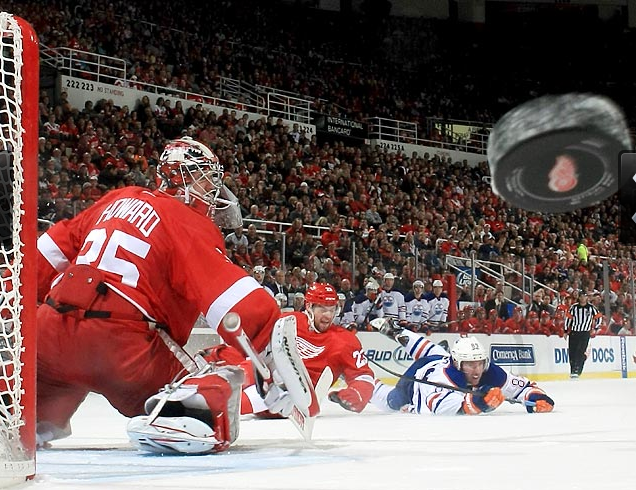
Sports Photography is a distinct genre of still photography, because it captures a moment of athleticism. It is defined by the action shot, which Rowe describes in his article "Framed and Mounted: Sport Through the Photographic Eye" is responsible for "reinforcing and conferring status on the elite sporting body by showing it doing the extraordinary things that so many people admire and envy." Sports photography displays a single moment of athletic distinction that makes the viewer stand in awe of the competitor and wish to either be a part of or witness that moment. The purpose of sports photography, like any other photography, is to draw the audience in.
To look for examples of Sports Photography, I visited Sports Illustrated Online to look at their Pictures Of The Week. Each photograph captures an intense moment--there is no photograph highlighted that is of a player or athlete merely spectating or waiting. The vast majority of the photographs were of male athletes engaging in intensely competitive confrontations, such as these...
Rowe comments in his article that there is a notable marginalization of women in sports media, which is made obvious by the fact that only 1/3 of sports photography is of women. Out of 18 photos of the week, only three depicted female athletes, all of whom are performing independently without direct interaction with a competitor..
Of the remaining 15 photos, 14 display men, with only one other exceptionally cute, marginalized form of athlete represented...
Woof. I'm sorry... If a puppy on a treadmill isn't the cutest thing you've ever seen, you're wrong.
In their article "Digital Still Photography," Quinn and Filak argue that still photography is more powerful than video, because rather than displaying images for a passive audience, still photos allow the viewer to chose how to long to look and where. This concept was fascinating to me, and I immediately flashed back to the 2012 Summer Olympics in London when McKayla Maroney executed a perfect routine on the vault. There were pictures and videos all over the internet documenting her vault.
While some might argue that the still photography is more powerful at depicting the intensity of a moment, I think that they are powerful in different ways. With a video, you can see the full effect from beginning to end. As an example, I've attached a video clip of Maroney's vault routine.
It is undeniable that watching the whole performance from start to finish is unlike anything else. Her execution is perfect, and her ability is amazing. However, there is a different kind of power to a still photo--no more powerful, no less powerful. It is simply achieves a different purpose. A still frame captures the intensity of a single moment in time.
The other thing I found interesting about Quinn and Filaks's article was the idea that even photojournalists need to be held to ethical standards. Photojournalists, just like regular journalists, they are capable of skewing the truth, and so skewing public opinion. Quinn and Filaks urge that photojournalists must use their photographs to "tell a story that reflects what actually happened." While photographers don't need to use a method of verification, they do need to ensure that there is minimal interference with the integrity of a photograph, event, or article.